Last updated August 2026
The question every Christchurch parent asks first
“How old should they be before we start?”
★View the Best Swimming Schools in Christchurch→It comes up constantly, and the honest answer is earlier than most people expect, but with a caveat that matters more than the number. What a nine-month-old gets out of a swimming lesson is not what a five-year-old gets, and if you go in expecting the wrong thing you will conclude it is not working when it is working exactly as intended.
Here is what actually happens at each stage, what to look for in a swim school, and the one policy question worth asking before you enrol.
Why New Zealand takes this seriously
We swim more than most countries and we drown more than most countries, and the risk is not distributed the way people assume.
Water Safety New Zealand’s analysis of drownings between 2005 and 2019 found that home swimming pools, including portable ones, are the leading location for fatal drownings among children under five, and that children aged 0 to 4 are around fifteen times more likely to drown in a home pool than at a beach. Over that period there were 89 fatal incidents in that age group and hundreds more hospitalisations.
The takeaway is not that beaches are safe. It is that the dangerous water is usually much closer to home than anyone pictures, and that supervision, fencing and swimming ability all sit alongside each other rather than substituting for one another. Water Safety New Zealand has current guidance on home pools.
What babies and pre-schoolers actually learn
Lessons at this age are not swimming in the stroke sense. Nobody is teaching a one-year-old freestyle.
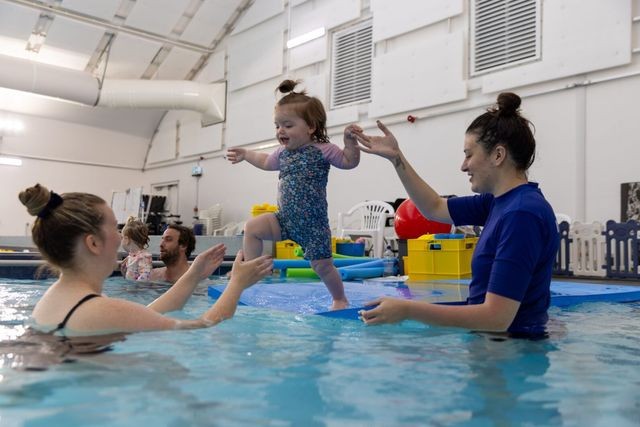
What they are teaching is water confidence and one specific survival skill: rolling onto the back, floating unaided, and moving to the side of the pool. That is the sequence that matters if a small child ends up in water unexpectedly, and it takes a long time and a lot of repetition to become automatic.
The other half of it is the parent. Baby classes are in-water with a caregiver, and a large part of the value is a parent learning how to hold, support and read their own child in water, which is a skill in itself, and one that transfers to every bath, paddling pool and holiday from then on.
Progress at this stage looks like very little for a while and then a lot at once. That is normal.
The flotation aid question
This is the one worth asking a school directly, because schools genuinely differ and the reasoning is not obvious.
Many swim schools do not use armbands, floaties or other flotation aids at all. The argument is twofold. First, they give both parent and child a false sense of security around water. A child who is confident with armbands may be confident without them, at exactly the wrong moment. Second, they hold a child in a vertical position: head up, feet down, arms out, legs cycling. That is the posture you least want a child defaulting to, because vertical is the drowning position, and it works against the horizontal balance that swimming actually requires.
Schools that avoid aids teach buoyancy and back-floating from the start instead. Whichever approach a school takes, ask them why they take it. A school with a considered answer is telling you something useful about how the rest of the programme is designed.
School age, and what “learning to swim” really means
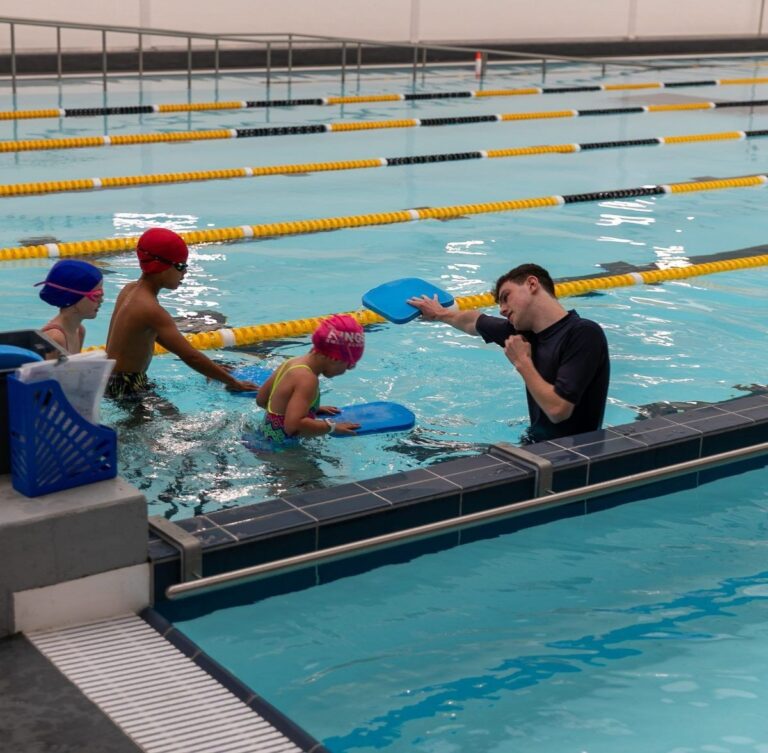
From five upwards the goal shifts to competence: the four strokes, breathing, distance, and being able to look after yourself in water that is not a teaching pool.
Two things are worth being realistic about. It takes years, not terms. Most children are looking at a multi-year progression, not a single summer. And it is not linear; children plateau, sometimes for months, particularly around the point where breathing has to become automatic. A plateau is not a sign the school is failing.
What to look for in a Christchurch swim school
- Teacher training. Ask how teachers are trained and how many supervised hours they do before taking a class alone. This is the single biggest driver of quality and almost nobody asks.
- Class size and ratios, especially for the youngest groups.
- Water temperature. Small children lose heat fast, and a pool that is fine for squad training is miserable for a toddler.
- Whether they teach to a defined progression you can actually see, so you know what your child is working towards.
- How they assess and place a child who has swum before.
- Practicalities: parking, changing space, whether siblings can be scheduled back to back. These decide whether you are still going in six months.
Adults count too
A surprising number of New Zealand adults cannot swim confidently, and quietly avoid situations where it would show. Most schools run adult lessons, usually in small groups or one-to-one, and teachers who do this work are used to nervous beginners rather than surprised by them. It is never a strange thing to ask about.
Where Kings Swim School fits
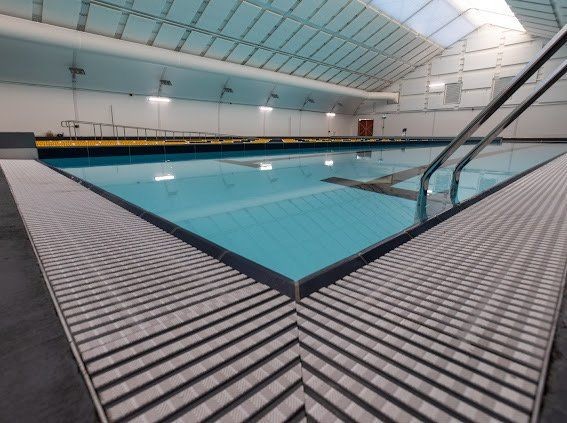
Kings Swim School was founded in 1993 by Todd Mason and Pam Berry-Mason and teaches from three months old through to adults at its purpose-built pool on Main South Road in Christchurch.
Todd has been involved in swimming since 1977, was a National Age Group Coach and part of the 2004 Athens Olympic swim team coaching and management group, and holds SNZ Level Three coaching accreditation. Pam spent 24 years in primary teaching, ten of them as an assistant or deputy principal. Both are active members of the NZ Swim Teachers and Coaches Association.
Kings does not use flotation aids, for the reasons set out above, and teaches back-floating and rolling from an early age. Their babies and pre-school programme explains the approach in full. Teachers complete a minimum of 20 supervised training hours before taking a class solo.
If you are not sure which level your child belongs in, there is an online assessment tool on the site, and the FAQs cover enrolment, class types and what to bring. Reception is on 03 341 7579.